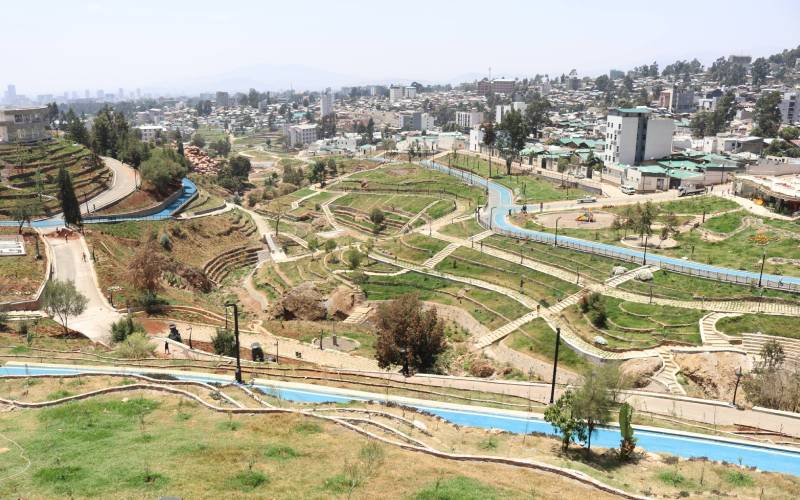
View of Addis Ababa, the capital of the Federal Democratic Republic of Ethiopia and the headquarters of the African Union | Photo Credit: Michael Dewornu |
Standing along the renewed riverbanks of Addis Ababa, it is hard to imagine that the beautiful parkland stretching before visitors today was once a neglected dumping ground. Clean walkways now follow the flow of the river, decorated with a bluish paint that reflects the view of the seasonal river. Families stroll through landscaped gardens while other take their rest hanging around there to pass their day. Cafes and recreational spaces have replaced what residents once described as dark corners used for illegal dumping and criminal activities.
The transformation is part of Ethiopia’s ambitious beautifying Sheger Project, a major urban renewal initiative designed to rehabilitate rivers and turn neglected land into green public spaces. For Ghana, where many former landfill sites remain abandoned and hazardous, Ethiopia’s experience raises an important question. Could our dumpsites also become engines for tourism, urban renewal and economic development?
A Vision to Transform a City
The riverside redevelopment in Addis Ababa was launched in 2019 by the Ethiopian Prime Minister Abiy Ahmed as part of the broader effort to beautify the capital and reposition it as a tourism destination. The initiative stretches about 56 kilometres of waterways, transforming riverbanks from the foothills of Entoto to the Akaki area into parks, pedestrian walkways and recreational zones. One of the flagship developments within the project is Sheger Park, also known as Friendship Park, located in the heart of Addis Ababa.
The park which was commissoned in 2020 features artificial lakes, fountains, gardens, event spaces and public plazas designed for leisure, culture and tourism. What makes the transformation remarkable is what the area used to be. Before redevelopment, the riverbanks were largely abandoned spaces filled with weeds, household waste and industrial refuse. The area had become a place residents avoided.
But today, the same site has become one of the capital’s most visited public spaces, drawing tourists, residents and businesses to its attention.
Environmental Restoration Meets Urban Tourism
The Ethiopian riverside project was designed not just as a beautification exercise but as a comprehensive environmental and economic strategy. Urban planners cleaned polluted riverbeds; installed drainage and sanitation systems and created green corridors that help reduce flooding and improve air quality.
Parks and gardens were also integrated into the design to absorb rainfall and cool surrounding neighbourhoods, improving the quality of life for city residents. At the same time, the redevelopment created vibrant public spaces where people could gather for recreation, cultural events and social activities.
The project further stimulated economic activities. Construction alone have created thousands of jobs, while the completed parks now support businesses such as restaurants, landscaping services and tourism operations. According to planners, the transformation is helping position Addis Ababa as a destination for urban tourism while revitalising the domestic economy.
Turning Environmental Liabilities into Opportunities
Ethiopia’s urban renewal story highlights an important principle: environmental problems can become development opportunities when approached strategically. Across many African cities, landfill sites and polluted urban waterways represent some of the most visible environmental scars.
In Ghana, examples include old dumpsites that have been closed but remain underutilized. These areas often pose health risks, attract illegal dumping or become breeding grounds for crimes. The Ethiopian example shows another possibility. Instead of leaving such land idle, cities can transform them into green spaces, tourist attractions or renewable energy sites.
Lessons for Ghana
Ghana’s rapidly growing urban centres face mounting waste management challenges. Landfills such as those in Accra, Tema and Kumasi have historically struggled with overcrowding and environmental risks. However, the experience in Addis Ababa suggests several lessons Ghana could learn and adopt.
- Reimagining landfill sites as urban assets
Former dumpsites can be converted into ecological parks, sports complexes, urban forests or tourism sites. This approach not only improves environmental conditions but also creates recreational spaces for growing urban populations.
- Transfroming environment into economic development
Urban parks and green corridors can attract tourism, increase nearby property values and stimulate small businesses. The Ethiopian riverside project has already triggered economic activity in areas surrounding the parks. Ghana should do the same.
- Building strong partnerships
The Addis Ababa project involved collaboration between government, international partners and private contractors. Such partnerships are essential for large-scale environmental restoration projects.
- Investing in urban aesthetics
Clean, well-designed public spaces improve a city’s image and contribute to national pride. Cities such as Kigali and Addis Ababa have demonstrated how urban beautification can enhance tourism and investment. It is not difficult for Ghana to do the same.
A New Vision for Ghana’s Cities
Urban planners increasingly argue that cities must rethink how they use land that was once considered environmentally damaged. Across the world, former landfill sites have been turned into public parks, renewable energy farms and wildlife reserves. For Ghana, the opportunity is enormous.
Imagine if former dumpsites were transformed into:
- Eco-parks and botanical gardens
- Cultural and festival grounds
- Green tourism corridors
- Recreational centres for families
- Renewable energy parks
Such projects would have not only improved urban environments but also create jobs and support tourism.
From Waste to Wonder
The story unfolding along the rivers of Addis Ababa is more than just a city beautification project. It is a reminder that bold urban planning can change the destiny of neglected spaces. Where waste once piled up, visitors now gather for leisure, culture and recreation.
For Ghana, the lesson is clear.
With vision, investment and community participation, today’s landfill sites could become tomorrow’s landmarks. The question is no longer whether such transformation is possible.
Ethiopia has already shown us that it is.
Michael Dewornu is a journalist with the Ghana Broadcasting Corporation (GBC) and an AU Media Fellow 2026/27.
About the Author