
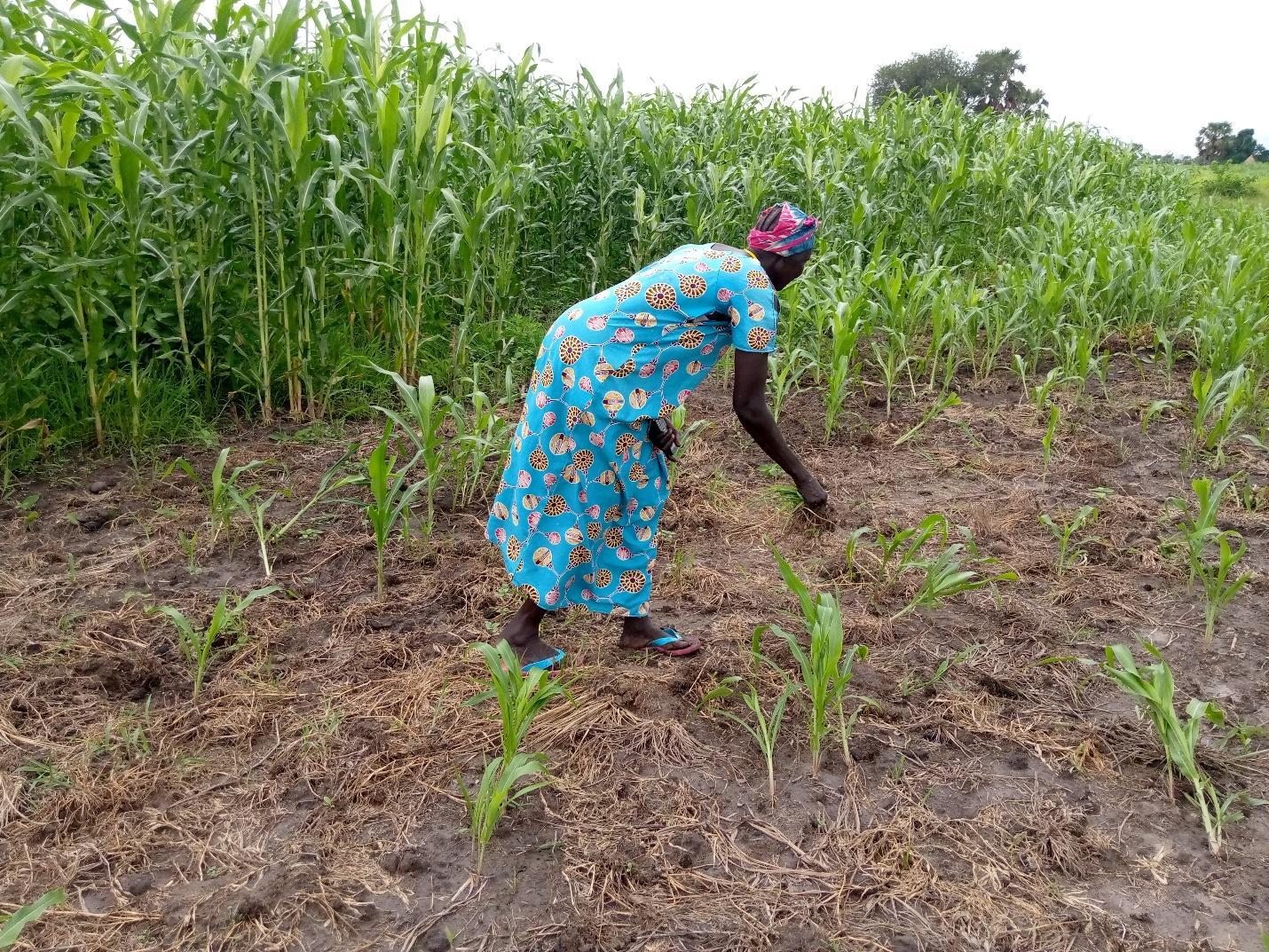
Adau Dhol picks weeds from her farm at Majak-alel in Jur River County, Western Equatoria State. Photo Credit: Mamer Abraham
By Mamer Abraham Kuot
The government of South Sudan, Food and Agriculture Organization (FAO) and the World Food Programme (WFP) have disclosed improved agricultural production in South Sudan in a report released Tuesday in Juba.
The latest Special Report titled 2025 FAO/WFP Crop and Food Security Assessment Mission (CFSAM) to the Republic of South Sudan, an annual joint initiative by FAO and WFP that assesses national food production, states that agricultural production increased in 2025.
CFSAM revealed that the net cereal production stood at a staggering 1.2 million tonnes, eight percent increase from the 2024 production and a 27 percent greater than the last five years average.
“The 2025 net cereal production in the traditional smallholder sector is estimated at about 1.2 million tonnes – eight percent higher than the 2024 output and 27 percent above the five-year average,” the statement partly reads.
According to the FAO/WFP Hunger Hotspots 2025 reports, acute food insecurity could deteriorate across 16 countries and territories from November 2025 to May 2026. It named the countries of the highest concern being Sudan, Palestine (Gaza Strip and West Bank), South Sudan, Yemen, Mali and Haiti with populations already facing catastrophic conditions.
The countries with the very high concern included Afghanistan, the Democratic Republic of the Congo, Myanmar, Nigeria, Somalia and the Syrian Arab Republic while Burkina Faso, Chad, Kenya and the Rohingya refugees’ situation in Bangladesh were also classified as hotspots. FAO and WFP further warned that the international community faced funding shortfall to prevent mass starvation and deaths in the hotspots of the highest concern.
CFSAM further revealed that food insecurity and malnutrition still exist in South Sudan compounded by conflict, climate and economic challenges.
“Agricultural production has improved over the last year in South Sudan, but high levels of acute food insecurity and malnutrition persist because of conflict, climate and economic challenges as well as persistent structural vulnerabilities,” reads part of the joint press release.
Call to action
Lily Albino Akol, South Sudan’s Deputy Minister for Agriculture and Food Security mentioned that CFSAM findings stated explicitly the obstacles faced by households across South Sudan. She assured citizens of the government’s support on installing resilient food systems to support their livelihoods amidst growing economic crisis and exorbitant market prices.
”The Government is committed to working with partners to build resilient food systems, support our farmers, and ensure that increased production translates into improved food access and nutrition for all”, said Akol.
Felix Dvzurumi, FOA’s Country Representative in South Sudan pledged that FAO would continue to provide its support to bolster the agricultural systems in the world’s youngest nation.
“FAO remains committed to supporting the Government of South Sudan to strengthen agricultural systems by improving seed systems, expanding access to extension services, and promoting climate-smart practices, so that farmers can sustainably increase production, protect their livelihoods, and contribute to long-term food security and resilience,” said Dvzurumi.
From July 2025-June 2026, an over 3.2 million people including 2.1 million children under five years and 1.1 million pregnant and breastfeeding women are projected to suffer from severe malnutrition.
Adham Effendi, WFP’s acting Country Director in South Sudan called for urgent mitigation efforts to cushion the growing food insecurity across the country.
“This situation requires urgent attention and coordinated action to mitigate the impacts on vulnerable populations,” said Effendi. “WFP is scaling up assistance to meet the most vulnerable people’s food needs,” said Effendi.
Five-year plan
South Sudan’s Food and Agriculture Compact, a five-year project is aimed at increasing food production, improving food security and nutrition. It is in line with the government’s strategy to transform South Sudan’s agriculture and livestock into a thriving sector and an integral part of inclusive growth and economic diversification.
It envisages sorghum production of 480,000 tons by 2027 aimed at 100 percent food security and surplus production of 100,000 tons, expansion of cultivated area, improved input supply, good agronomic practices and proper postharvest handling.
It aims to increase rice production to 100,000 tons by 2027 and cultivated land to increase to 16,000 hectares. Production is expected to increase from 0.7 tons per hectare to 6 tons per hectare, improved soil and water management, and improved climate rice varieties.
Another benefit of this plan will be increased sesame production from 26,000 tons to 100,000 tons by 2027 as a result of increased acreage area, pest control and reduce post-harvest losses.
It also aims to improve fish self-sufficiency and place South Sudan as the leading fish exporter by 2027. Fish production under this plan is projected to reach 200,000 tons of fish per year.
The project is set to achieve this through development of fishery value chain, modernization of the fishery sector by involving the private sector, rehabilitation of ice plants and cold storage facilities as well as intensive commercial aquaculture and reduced post-harvest losses.
The compact has invested approximately $1.15 billion US Dollars covering sorghum, rice, livestock, fisheries and sesame productions by 2027. It is therefore projected to improve livelihoods of more than 500,000 farming and fishing households and creating employment, services and markets to more than 2.5 million people.
About the Author
